
Memorial fixing: Techniques explained - Bases and kerbsets
Written by: Richard Whale
Published: 22nd April 2026

In our last blog, Richard, J.Gumbrill’s senior Monumental Mason, talked us through the process of fixing an ‘out of ground’ memorial. This week, he explains what is different when the memorial features a base or kerbset. Richard has worked for the J.Gumbrill for over 15 years. He holds the British Register of Accredited Memorial Masons Fixer License and is on the register of the National Association of Memorial Masons (NAMM) Register of Qualified Memorial Fixers. This means he is using techniques intended to meet British Standard BS8415. This time, we use his expertise to consider memorials with bases or kerb surrounds. Bases come in a range of sizes, and kerbsets are long pieces of heavy stone. What needs to be done to ensure that a carefully-considered monument to a loved one is fixed safely upright- and how do you then make sure it retains its integrity for years to come?
I see how memorials used to be put together because of the renovation work I carry out for J.Gumbrill. Memorials weren’t put together in the same ways and the materials were very different. If you use iron, it’s almost inevitable that it will deteriorate. We understand more now. What NAMM says is gospel– the guidance is extensive and it tells you how to do everything. Safety is so important- for me as the fixer while I am carrying out the work, but the memorial needs to be stable and remain solid in place. It’s designed to stand for many years. Working to a British Standard gives you a definitive operating method.
Compared to the past, these days we understand so much more about how to keep them upright. Once upon a time, a headstone with a base was just sat on a flat piece of stone underground. That might work in the short-term, but ground shifts over time and that lack of stability will lead to issues. In an extreme example, subsidence on one side of the stone can cause it to snap in half eventually- the inner fixings can’t do enough to maintain its integrity.
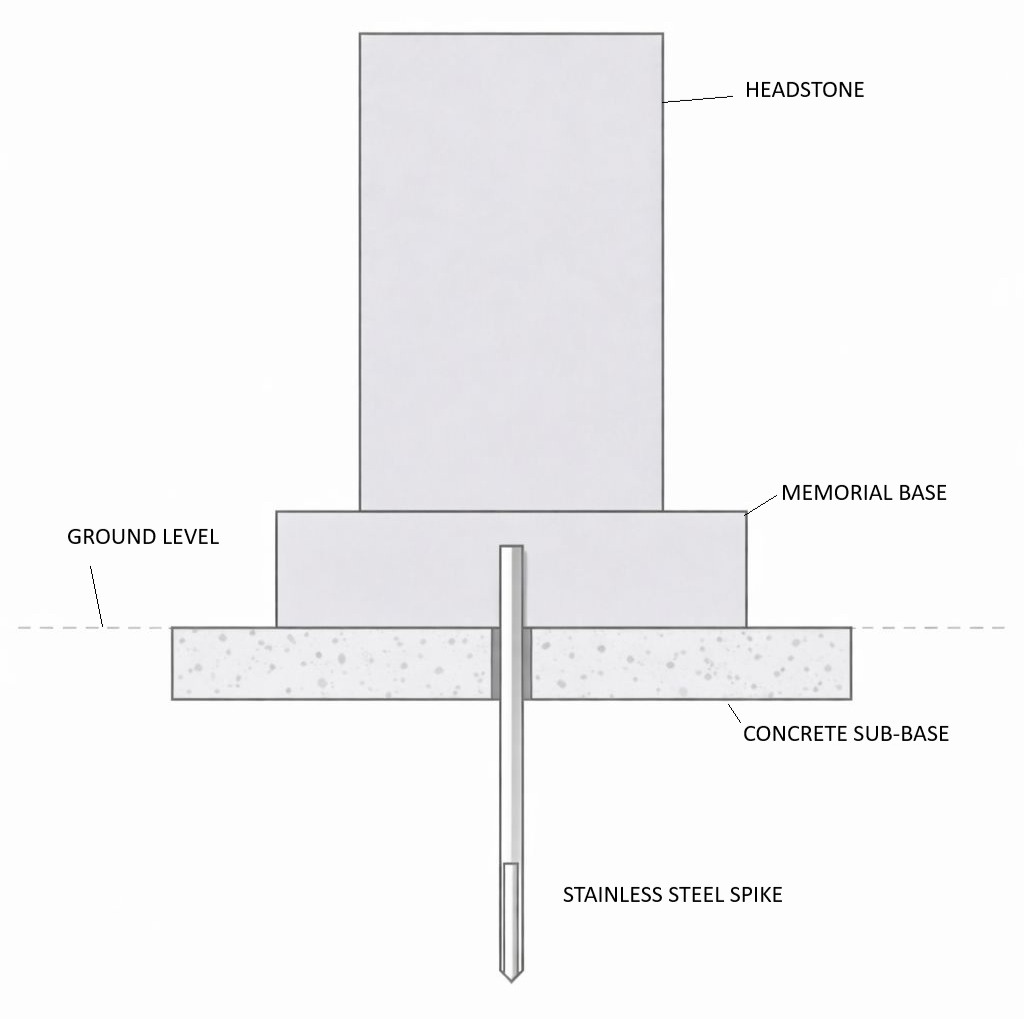
These days, we use a reinforced concrete foundation for headstones with bases. This will be 3” thick and bespoke to match the shape of the base while being slightly larger in size. The foundation sits just below ground level so that it isn’t visible and doesn’t detract from the memorial’s appearance. This base will then be secured to the ground by way of a ground anchor, a stainless steel rod and inch thick and almost two feet long. The majority of this sits in the ground to keep the base in place and it then extends up into the headstone itself. A three-inch deep bore hole will be filled with concrete and sit over the ground anchor.
The headstone is also attached to the base with dowels. These are slightly smaller, and their size varies depending on the memorial’s overall dimensions. 16mm diameter would be standard. These are also threaded which adds to the stability of the headstone while also enabling a slightly smaller size. A dowel can’t be so thick that it affects the monument’s internal integrity and the threading helps with this as well. As mentioned, all of the metal used is stainless steel which prevents degradation and warping, even underground.
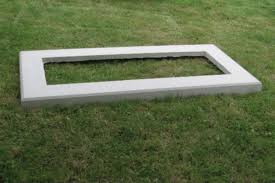
If the memorial also has a kerb surround, a similar method is used with a much bigger foundation. This is called a landing frame and is a piece of 3” thick concrete, which can sometimes be six feet in length- obviously, manoeuvring and siting it safely are of prime concern. In this case, each component of the kerb surround and the memorial’s base is cemented to the base. All of the components will be dowelled to each other to ensure the integrity of the overall structure as well as each piece sitting securely.
Ground conditions make a big difference to how you are able to work. The ground around the shoe has a big impact on the practicalities. Soil that has a lot of clods can cause issues if it makes it hard to dig the ground with precision as extra pieces can break off and enlarge the site, and the size of the hole you are preparing is important, as you don’t want to disturb more ground than you need to. Wet soil can cause different problems. It can make things harder. At very wet times, we may delay the installation because soil has to be able to assist in bearing the weight while the cement is drying, and this won’t happen if it’s too wet.
While these memorials do need work to be done to prepare them for installation, it’s all thought through. When you are imposing joints on the structure, it’s all bespoke to consider the weight, the dimensions and what is necessary. You weigh up what is needed, and that’s part of what my experience and training have taught me. Above everything, I always have to consider that I am in a burial place, working on someone’s grave or ashes burial site and usually near others. I have to be respectful to minimise disruption to the surroundings and, of course, you can’t disturb any coffin that is in place. Working cleanly and efficiently is important, too.
You can see more about different shapes of bases and how they change a memorial’s appearance by visiting our Shapes and Sizes page. Or why not get in touch with any questions? Our advice is free and backed with years of expertise.
Thanks for your time, Richard.