A day in the life of a letter cutter
Written by: Annissa Cole
Published: 9th September 2026

You might wonder what a day in the life of a letter cutter looks like. J.Gumbrill’s letter cutting team are true craftsmen with years of experience. This includes not only memorial masonry but prestigious projects such as War Memorials, Cathedrals and Royal Palaces. Here, Paul, one of the team, talks us through a typical day.
I arrive at J.Gumbrill’s workshop at 8.00am. My first task is to plan the day. Although we have a target completion date for each memorial, this isn’t the only factor that impacts me. For example, I may be waiting for an urgent amendment to a design, so will work on tasks that can be easily stopped until it comes in.
I have three memorials that I need to work on today. Two are sandblasted and it makes sense to work on them sequentially. The sandblaster takes time to ‘warm up’, so making sure it’s turned on and prepared is often an early task.
The first memorial has a computer cut stencil. I move the blank headstone into the cutting room. The stencil for the characters is printed onto rubber which is then carefully applied to the stone. Once this is done, I can sandblast the inscription. This process takes about an hour in total.
This memorial, and the next one, both have lettering in the same paint colour so I leave this one for now and move to the second.
The second headstone is a hand-cut stencil so takes longer. I apply a blank stencil rubber to the stone and then hand-draw the characters. This is painstaking work. Not only the inscription itself, but also the size and spacing of the characters must be correct. Once I have pencilled all the letters in, and am satisfied with the design, I carefully cut each one from the rubber with a Stanley knife. It can then be sandblasted.
Once both inscriptions are blasted, I mix enough paint for both sets of lettering and paint the first coat on both inscriptions. This minimises wastage, but I also find this way of working to be more efficient for me.
The time needed to prepare an inscription and sandblast and paint, varies depending on inscription length and complexity. In this case, I’m ready to move onto my next piece of work by 11.45am.
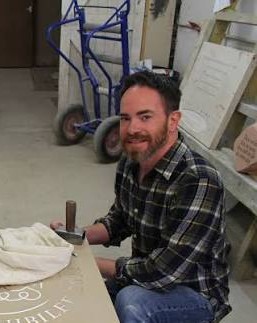
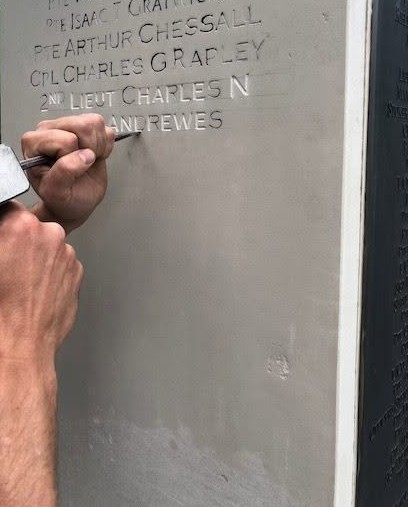
I move the third memorial into the cutting room. This is different to the others I have worked on earlier: the lettering, and requested rose motif, will be hand carved. First, I sketch out the lettering and roses in pencil on the face of the memorial. I trained as a fine artist and like adding details like flowers to a headstone. Once complete, I begin chiselling. Hand carving takes a lot of time. I will aim to finish as far before the target completion date as I can, but I will go back to this memorial over several days or perhaps longer. Because of my experience, I can usually tell how long a piece of work will take. I can therefore balance doing a part of the overall task with ensuring it’s a quality job- which doing it in smaller pieces helps ensure. I spend about two hours on this today.
At 2.00pm, I meet with Annissa, J.Gumbrill’s Monumental Masonry Administrator, at the workshop. We meet regularly so I understand where we are from an admin perspective. She usually gives me a list of drawings for new memorials. These are important- they show customers their proposed design, and, in due course, act as one of the documents I use to check my work. There may be previous drawings where the customer has requested an amendment. Simple changes can be made while Annissa waits. We discuss upcoming memorials and progress on current ones. Annissa advises if any information has changed, for example if a customer has asked for a nearer completion date.
There may be more exceptional requests. Some work- such as restoring a War Memorial- might need to be done onsite and I may need to carry out an appraisal visit. Or there may be a headstone requiring work in situ, and we need to decide when this could happen.
Once we are finished, I check the day’s work, shut off the sandblaster and any other equipment and tidy up so everything is in its place for the next day. I usually aim to finish at around 4.00pm.
This is a ‘normal’ day, but no two days are the same. Richard or Daniel collect memorials for installation from the workshop, and we take this opportunity to discuss how pending work is progressing. I may need to work off-site, so this will be completely different. The workshop receives deliveries from suppliers, and I’ll always do a first examination to check the goods are of the right standard. There may be enquiries about timescales and costs for prospective designs. I also need to set aside time for preparing drawings. Lastly, customers sometimes want to see the proposed design on the memorial before I begin carving. Memorials are supposed to be a lasting monument, so it’s important the customer is happy. If needed, we can meet at the workshop, and they can see what is proposed and give feedback, in the interest of achieving their desired finished product.
From admin to lettercutting to installation, all of the J.Gumbrill team is committed to the highest standards of service and care. For any queries about monumental masonry, please do contact us.
Thanks for your time, Annissa.