
Stones explained: Granite
Written by: Wilf Freeman
Published: 20th May 2026
In the first of an occasional series called ‘Stones explained’, Wilf Freeman tells you everything you may ever have wanted to know about Granite.
What is Granite?
Granite is a coarse-grained rock of the igneous type. ‘Igneous’ rock is that formed by the cooling of molten magma or lava. Granite is an ‘intrusive’ or ‘plutonic’ igneous rock, meaning it is made from magma, which has cooled slowly beneath the earth’s surface. This slow cooling which has led the larger crystals within the stone to grow. It is typically composed of quartz, alkali feldspar, and mica.
Granite is quarried in many different parts of the world. Although the major quarries are in India and China, there are large sources in South America (Brazil) and North America (especially near Vermont). Closer to home, Spain, Italy, Sweden, and Germany are significant producers and there are also quarries in the UK. . Leicestershire’s Mountsorrel Quarry produces distinctive pink granite which formed around 450 million years ago.
What are some of the characteristics of granite?
Granite is known for being very hard and durable. It is also heat-resistant, making it a popular choice for products as diverse as rail ballast and kitchen worktops.
Granite is known for coming in a wide range of colours. This is due to the mineral composition in the underground area where it cooled and formed. As well as the best-known black and grey colours, granite comes in paler greys, some of which look almost white. It also comes in blues, reds and pinks, greens, and brown/gold/yellow shades. Some of these are very rare.
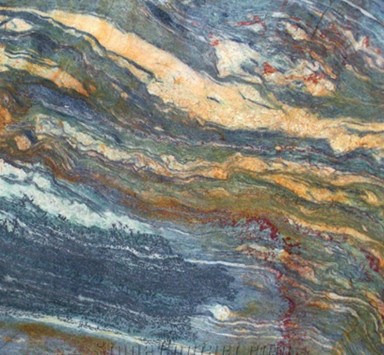
There are also some multicoloured granites, such as ‘Van Gogh Granite’, so-called because it replicates the colours the famous artist used in his paintings. These are not used for monumental masonry because of their cost, but also because the lack of consistency makes it hard to choose lettering that works across the piece.
Some otherwise-similar looking granites are distinguished from each other by the type and quantity of veining within them. For example, Karin and Norden are both mid-grey granites which are often used for memorials. However, Norden is more consistent in colour, and its veining is less prominent. Karin’s grain is less fine and can feature darker veins and spots.
Granite can be polished, for a shiny, light-reflective surface, or honed. Honed surfaces are matte or have a soft sheen, this is often called an ‘eggshell’ finish.
How does using granite for a memorial impact on our choices?
Firstly, choosing granite has some implications in and of itself. You will need to have the inscription and any chosen ornamentation sand-blasted onto the memorial. Granite is a very hard material, and this makes lettering or decorating it by hand very difficult and time-consuming. The good news is that, if you prefer a more bespoke finish, our lettercutting team can create a stencil for the sandblasting by hand.
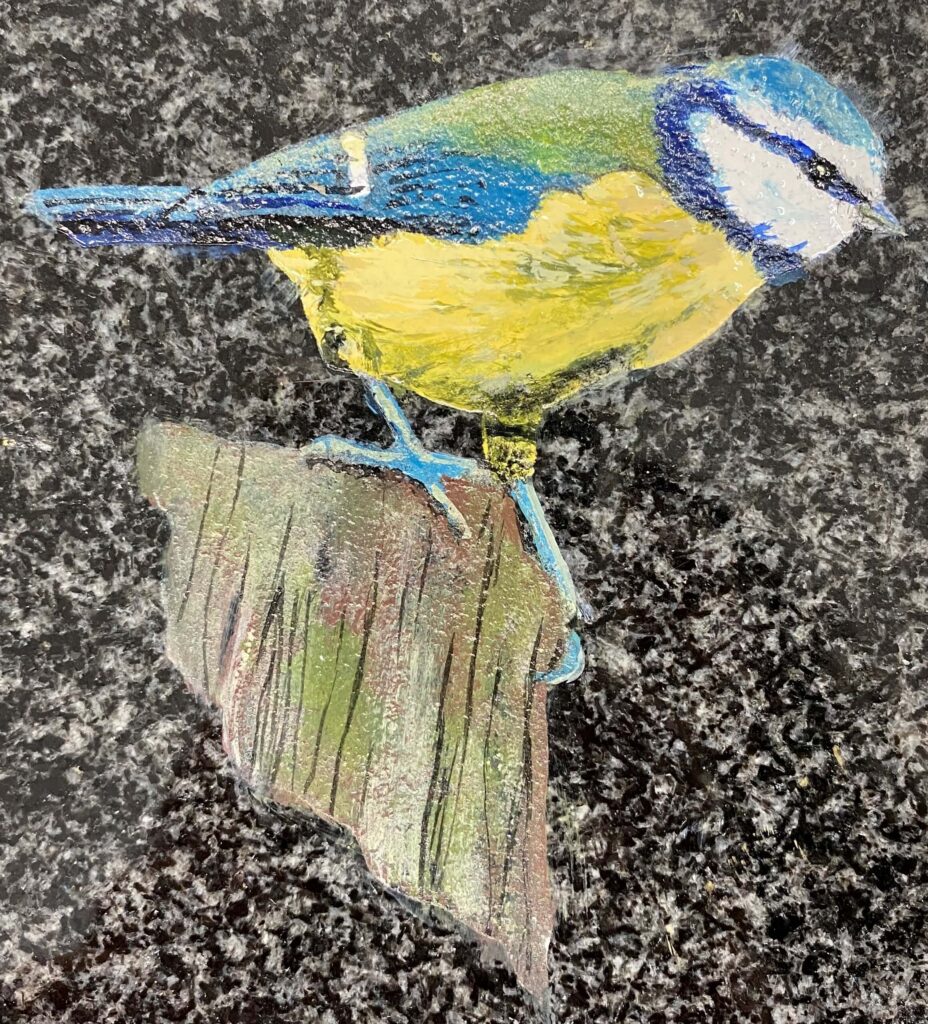
However, the type of granite you choose will also have an impact on other design features. For example, if you choose one of the darker colours, you will need to choose a lettering colour that stands out against the stone. Any designs such as flowers or animals will need to be painted in bright colours to be prominent: this is not a subtle effect. The paler granites, also require painting, but can take less contrasting colour palettes.
Like all stones, granite is a natural material but, if you choose a granite which has prominent veins, you have to be aware that this can occur anywhere on the memorial, including the ‘face’ designated to be inscribed.
Can we have a granite memorial in any setting?
Every burial place has its own rules and regulations, and these can cover some or all of the following:
- Shapes and sizes of permitted memorials
- Colours of inscriptions and guidance as to allowed wording
- Type(s) of materials allowed
- Colour and finish of materials permitted
While you may well be allowed a granite memorial in many settings, this does not necessarily mean you can have a memorial of any colour of granite. For example, many Church of England churchyards in J.Gumbrill’s area will only allow a light- to mid-grey granite in a honed finish. This means you cannot have a memorial made of any of the darker or coloured granites, and you may not have a polished memorial. Gold, silver, black, or white lettering is not allowed, either. This is not surprising when we consider that the aim of a churchyard is to provide an atmosphere of harmony rather than any individual memorial standing out as prominent. It does mean that compromises will need to be made over aesthetics, though.
Similarly, there may be other burial sites that stipulate only headstones of a certain shape and size, or even only identical stones to be permitted. It is important to understand the rules of a burial place before proceeding with the commissioning of a memorial. Part of J.Gumbrill’s role is to ensure that your choices meet with the regulations.
If you would like to understand more about how granite compares to other types of materials, then why not visit our ‘Stone Types’ page, which has lots of useful information.
Thanks for your time, Wilf.