
Memorial fixing: Techniques explained -Upright memorials
Written by: Richard Whale
Published: 8th April 2026

Richard, J.Gumbrill’s senior Monumental Mason, has worked for the company for over 15 years. He is on the register of the National Association of Memorial Masons (NAMM) Register of Qualified Memorial Fixers, meaning his work meets British Standard BS8415. He also holds the British Register of Accredited Memorial Masons Fixer License. Who better, then, to talk to us about the techniques used to fix memorials into place? This time, we look at memorials ‘straight out of ground’. This is where the memorial’s face seems to rise directly out of the ground, uninterrupted by a base. To the uninitiated, this seems a daunting challenge- many memorials can be four feet in height and are heavy as a result. What needs to be done to ensure that a piece of stone this size stands safely upright- and how do you then make sure it retains its integrity for years to come?
One of the main advantages about fixing memorials today is we understand so much more about how to keep them upright. For example, when a headstone is placed straight in the ground, you only see part of the overall memorial’s structure. Another twelve inches of the stone will be underground to help with balance and overall stability. This means that a memorial intended to stand three feet out of the ground is in fact four feet high, and so managing the safe transportation and erection of something this big is a challenge.
To site a memorial straight into the ground, we use a specialist concrete ‘shoe’ to anchor it in place. This is a block approximately three inches thick which extends into the burial plot, with a slot at the top. It acts as a counterbalance to the weight of the upright memorial. These are dug into the burial plot around fifteen inches under the ground, to allow for the thickness of the shoe itself and then enable the memorial to slide into it. They are substantial pieces of concrete, weighing approximately 60kg.
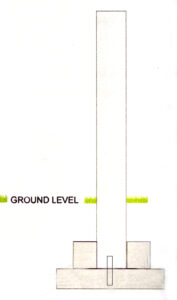
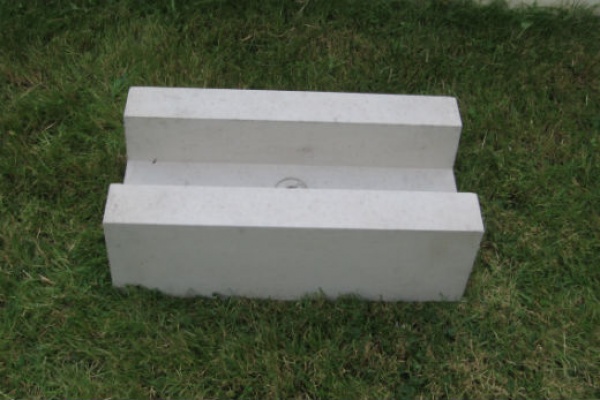
This shoe is cemented into the ground once the site has been excavated. Further cement is then used to secure the memorial itself into the shoe and then the site is refilled. The ground around the shoe has a big impact on the practicalities. For example, if the soil is very wet, we may delay the installation until it has dried out because it has to be able to assist in bearing the weight while the cement is drying- and this won’t happen if it’s too wet. Alternatively, a soil that has a lot of clods can cause a different problem if it makes it hard to dig the ground with precision as extra pieces can break off and enlarge the site.
These types of memorial are quite simple in construction and that’s deliberate. The aim is to minimise the amount of joints you are imposing on the structure. This means you don’t need to add rods and pins which can sometimes come with risks of altering the structural stability of the memorial itself. That doesn’t mean the installation is easy, though. Getting the shoe into the ground can be difficult depending on location or ground conditions. One of the fundamentals to be considered is that you are working with someone’s grave or ashes burial site. You have to work cleanly and respectfully to minimise disruption to the surroundings and, of course, you can’t disturb any coffin that is in place.
The advantage to being a member of NAMM is that you have all the guidance you need of the best ways to fix memorials safely. This is safety for me as the fixer but also ongoing. It has to be stable and remain solid in place. Because it’s a British Standard, it’s the definitive way of doing things.
We do memorial restorations as well and so I see how things used to be fixed. It was very different once upon a time. A lot of my renovation work is re-siting upright memorials that have begun to lean and often there isn’t a base of sufficient weight and size to sufficiently counterbalance the memorial, or enough of the memorial itself underground to stop it becoming top-heavy. It’s nice to be able to do things better these days and I feel a lot of the memorials I erect will stand proud for years.
If you have questions about how memorials are installed or any other aspect of our work, then why not contact J.Gumbrill via our website. You can also learn more about different shapes of headstones by visiting our Shapes and Sizes page. We are always happy to use our expertise to give as much advice as you require.
On our next blog, Richard explains to us how memorials with bases are fixed.
Thanks for your time, Richard.